
ThermaCycle®: Field-Proven Adaptive Thermal Remediation, Engineered for the Whole Plume
In situ thermal remediation is one of the most effective tools available for addressing complex subsurface contamination — dense non-aqueous phase liquid source zones, recalcitrant compound tied up in tight soil lenses and transition zones, and the persistent dissolved plumes they sustain. But conventional high-temperature thermal systems are optimized for one objective: aggressive source zone volatilization. They are not designed for the broader remedial challenge — the transition zone, the dissolved plume, and the need for a single integrated platform that can address all three without remobilization or redesign.
At The Environmental Remediation Group (ERG), we built ThermaCycle® to do exactly that.
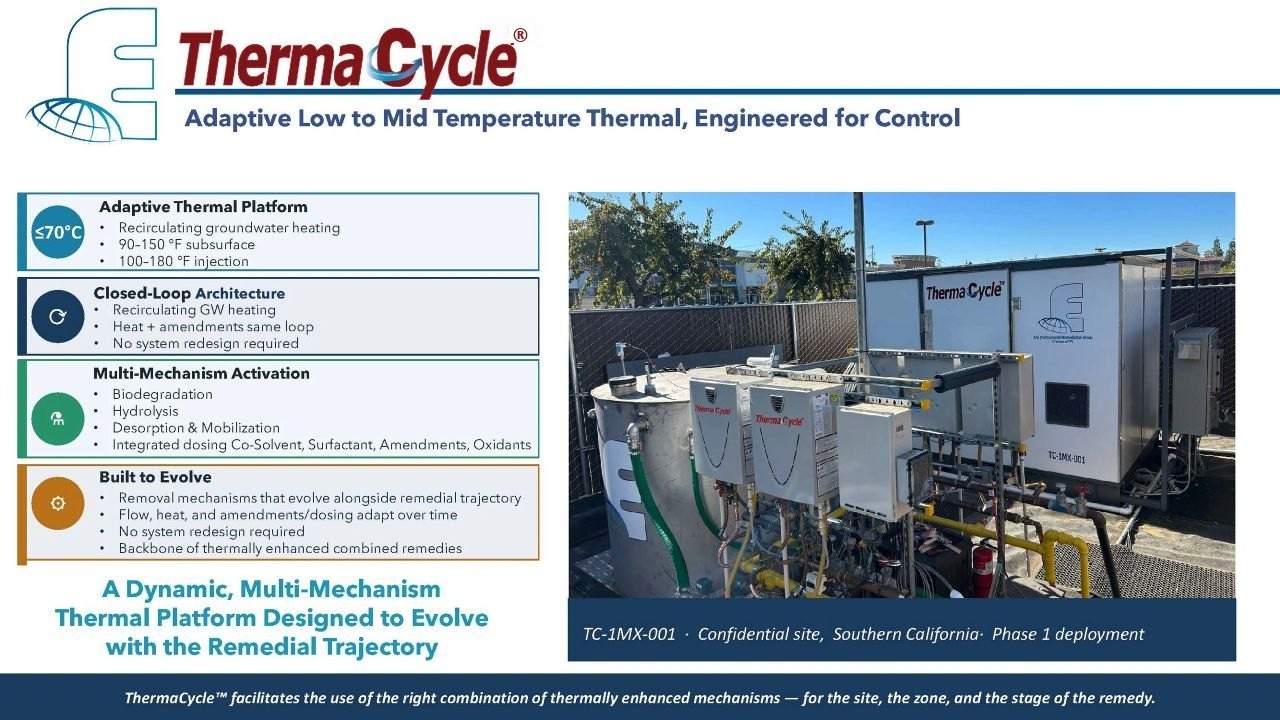
ThermaCycle® is ERG’s proprietary adaptive low-to-mid temperature thermal recirculation platform — a closed-loop, multi-mechanism system engineered to deliver heat, hydraulic control, and chemical amendments through a single integrated infrastructure, across the full spatial and temporal arc of a remedial program.
What ThermaCycle® Does
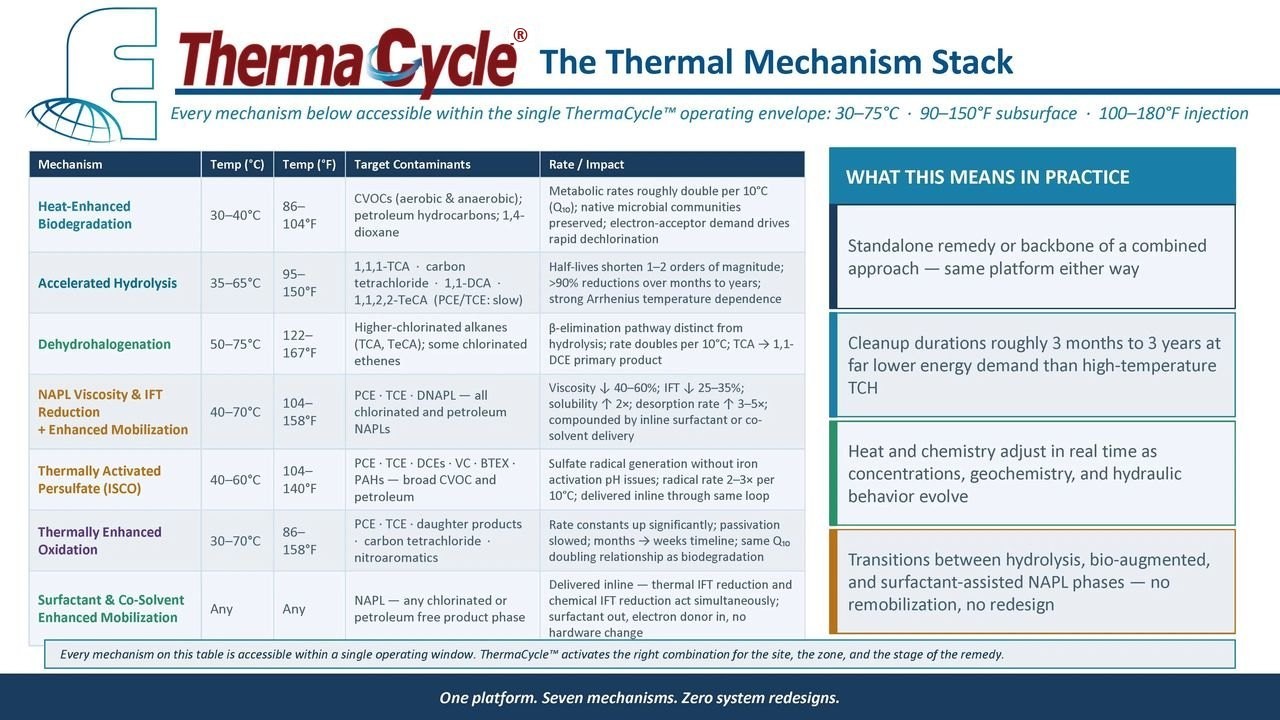
ThermaCycle® operates through a closed-loop recirculating groundwater architecture. Extracted groundwater is heated to 100–180°F for injection, achieving 90–150°F in the subsurface target zone. Heat and amendments travel through the same loop. The system is fully pre-piped, wired, and factory-tested before mobilization — housed in an 8.5 × 12 ft all-metal enclosure with Allen-Bradley PLC controls, real-time SCADA telemetry, automated alarms, continuous data logging, and optional Ignition-based SCADA backbone for remote adaptive management.
Flow range is 5–50 gpm, adjustable without hardware change. Multiple dosing tanks and pumps, inline ports, and a static mixer support the full range of subsurface chemistry — substrates, microbial cultures, surfactants, co-solvents, oxidants, reductants, and nutrients — all delivered inline with the heated recirculate through the same loop, without separate injection infrastructure.
This architecture is what separates ThermaCycle® from passive heating approaches. Heat delivery is active, continuous, and controllable. The thermal front is tracked in real time. Amendment delivery adapts as site geochemistry and contaminant concentrations evolve. And the entire system scales — in flow rate, footprint, temperature, and chemistry — without redesign or remobilization.
Seven Mechanisms. One Operating Envelope.
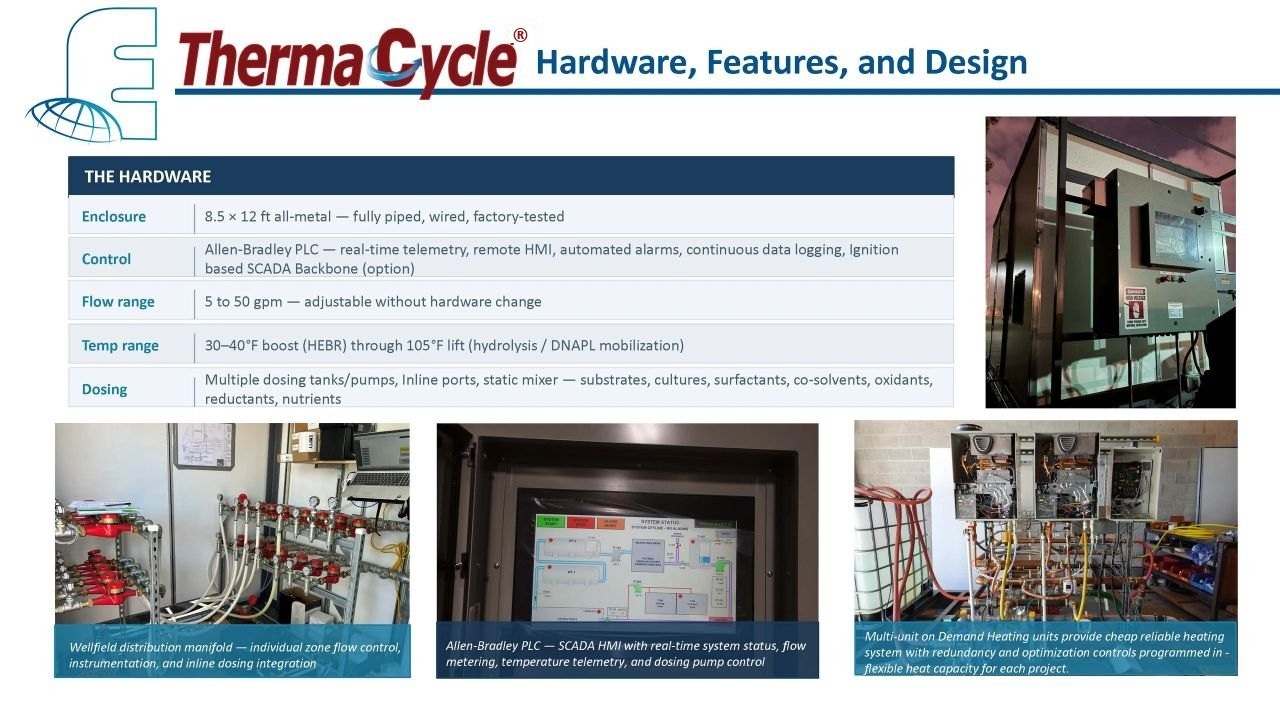
Within the single ThermaCycle® operating envelope of 30–75°C, seven contaminant removal mechanisms are simultaneously accessible:
Heat-Enhanced Biodegradation (30–40°C)
Metabolic rates roughly double per 10°C rise through the biological optimum window. Native microbial communities are preserved and accelerated. Electron acceptor demand drives rapid reductive dechlorination of CVOCs, petroleum hydrocarbons, and 1,4-dioxane. The Q₁₀ relationship governs both aerobic and anaerobic pathways.
Accelerated Hydrolysis (35–65°C)
Half-lives for 1,1,1-TCA, carbon tetrachloride, 1,1-DCA, and 1,1,2,2-TeCA shorten by one to two orders of magnitude. Greater than 90% mass reductions are achievable over months to years without biological augmentation. Reaction rates follow strong Arrhenius temperature dependence.
Dehydrohalogenation (50–75°C)
A β-elimination pathway distinct from hydrolysis targets higher-chlorinated alkanes including TCA and TeCA. Rate doubles per 10°C. TCA degrades primarily to 1,1-DCE — a distinct transformation product that confirms abiotic activity.
NAPL Viscosity Reduction, IFT Reduction, and Enhanced Mass Mobilization (40–70°C)
Physical property changes at low-to-mid temperature are strongly NAPL-type dependent. For viscous petroleum and MGP DNAPLs — coal tar, creosote, and heavy petroleum, which exhibit baseline viscosities of 20–100+ cP — heating to 30–70°C produces viscosity reductions of one to three orders of magnitude, transforming near-solid material into freely mobile fluid amenable to extraction.
For lower-viscosity chlorinated solvent DNAPLs such as PCE and TCE — which begin near 0.9 cP at ambient conditions — the meaningful thermal effects are aqueous solubility enhancement (approximately 2× for PCE and 1.5× for TCE) and desorption rate increase (3–5×). Interfacial tension decreases modestly with heat alone (~15–20%); the more substantial IFT reductions come from inline surfactant or co-solvent delivery through the same loop.
Thermally Activated Persulfate ISCO (40–60°C)
Heat activates persulfate for sulfate radical generation without iron activation pH management issues. Radical generation rates double 2–3× per 10°C. Delivered inline through the recirculation loop with no separate injection system.
Thermally Enhanced Chemical Oxidation and Reduction (30–70°C)
Rate constants increase significantly with temperature. Passivation of reactive media is slowed. Month-scale timelines compress to weeks.
Surfactant and Co-Solvent Enhanced Mobilization (any temperature)
Thermal IFT reduction and chemical IFT reduction act simultaneously. Switching from surfactant to electron donor delivery requires no hardware change — only a dosing chemistry swap.
One platform. Seven mechanisms. Zero redesigns
Reaching What Conventional Recirculation Cannot: Thermally Enhanced Contact in Fine-Grained Lithology
One of the most significant — and least-discussed — capabilities of ThermaCycle® is its ability to achieve meaningful fluid contact in fine-grained lithologies where conventional recirculation and injection-based technologies effectively fail to reach.
DNAPL migrates downward until it encounters a permeability contrast, pooling above fine-grained sequences and impregnating them at residual saturation. The contaminant mass stored in silts, sandy silts, and clay-silt interfaces is what sustains dissolved plumes for decades. It is the hardest mass to reach and among the most consequential to treat.
The Darcy Mechanism: Water Viscosity and Apparent Hydraulic Conductivity
Conventional recirculation operates at ambient groundwater temperature, typically 10–15°C, where water dynamic viscosity is approximately 1.1–1.3 mPa·s. ThermaCycle® delivers water at 40–70°C, where viscosity drops to approximately 0.65–0.40 mPa·s — a reduction of 43–65%. Under Darcy’s law, this increases apparent hydraulic conductivity by approximately 75–180% at the same applied gradient. A silt interval that ambient-temperature recirculation flows around is 2–3× more accessible to hot water.
Hazen identified this relationship in 1893 and temperature correction for fluid viscosity is standard hydrogeological practice. Temperature-induced increases in hydraulic conductivity have been confirmed across compacted bentonite, silty clay, clay, and silica sand.
Reduced Capillary Entry Pressure and Improved Wettability
Water surface tension decreases approximately 0.20 mN/m per °C, reducing capillary entry pressure by approximately 15% across the ThermaCycle operating range. In NAPL-contacted sequences, soil surfaces are partially NAPL-wetted — meaning capillary forces actively resist water entry. Elevated temperature shifts wettability toward more water-wet conditions, opening pore throats to water penetration that would require excess applied pressure at ambient conditions.
Co-Solvent Delivery: Compounding the Effect
Short-chain alcohols — ethanol, propanol, isopropanol — delivered at low volume fractions (1–10%) through the recirculation loop act on three compounding mechanisms simultaneously: NAPL density reduction via partitioning, IFT and capillary entry pressure reduction, and progressive recovery of water relative hydraulic conductivity in NAPL-saturated fine-grained intervals as mass is removed.
Propanol is deployed specifically in the ThermaCycle® Phase 2 design at the Southern California site for its documented ability to improve relative hydraulic conductivity in the tighter lower silt intervals immediately above the clay aquitard.
Honest Boundaries: Where ThermaCycle® is Not the Right Tool
ThermaCycle® extends effective recirculation reach into silts, sandy silts, and silty clays. It does not eliminate the constraints of flow-based remediation in the tightest geologic environments. In true clay-dominated sequences — dense clay aquitards, high-plasticity clay lenses, or clay-rich till — hydraulic conductivity is so low (often below 10⁻⁷ cm/sec) that even thermally enhanced recirculation cannot achieve meaningful matrix flux. Similarly, fractured bedrock presents a fundamentally different hydraulic architecture where recirculation-based contact advantages are substantially reduced.
ThermaCycle® was engineered for heterogeneous unconsolidated sequences: fine-to-coarse interbedded lithologies where DNAPL pools at permeability contrasts and dissolved plumes are sustained by back-diffusion from silts and sandy clays. That design space is where it performs.
The Low-Temperature Thermal Landscape: Platform Architecture Matters
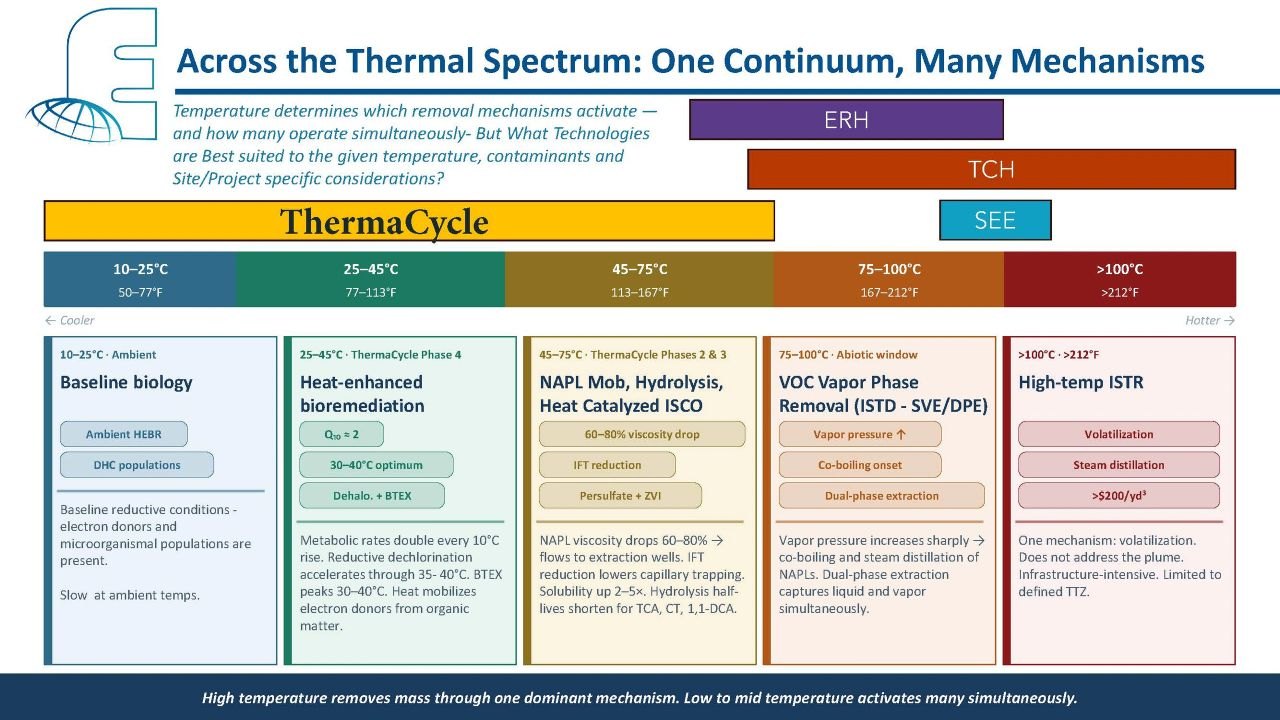
The remediation industry’s recognition of low-to-mid temperature thermal as a credible standalone and enhancement technology has grown substantially. Several approaches now exist, and understanding how their underlying architectures differ — and what those differences mean in practice — is relevant to selecting the right tool.
Conduction-Based Low-Temperature Approaches
TCH-based low-temperature systems rely on thermal conduction from a heat source outward through the soil matrix to the interwell centroid. This is a well-understood and reliable mechanism with predictable heat propagation across soil types.
The architecture has inherent geometric consequences that become more pronounced at low temperature. In any heater array, the last location to reach target temperature is the centroid — the geometric center equidistant from all surrounding heat sources. In conventional high-temperature TCH, heaters operating at 600–800°C create a large thermal gradient that drives heat aggressively toward the centroid. At low temperature, heater elements operate at much lower power output and smaller diameter. The thermal gradient driving heat to the centroid is correspondingly weaker, making the interwell zone heat more slowly and less completely. This is a direct consequence of the physics of conductive heat transfer.
This is compounded by a second limitation: these systems deliver heat and nothing else through their subsurface infrastructure. Amendment delivery requires separate injection infrastructure, separate operational events, and a separate hydraulic system. At sites where amendment delivery timing and distribution are critical to biological response — which is essentially every HEBR application — this separation limits the ability to respond adaptively to monitoring data, and limits hydraulic control, hydraulic capture, and active control of amendment and chemical delivery.
What ThermaCycle® Does Differently
ThermaCycle® was designed around a different architecture from the outset. Rather than conducting heat outward from a fixed heater to a passive soil matrix, it actively delivers heated fluid through the formation via recirculation — carrying heat, hydraulic control, and amendment chemistry simultaneously through the same closed-loop infrastructure.
Heat distribution is a function of the recirculation flow field, actively managed and monitored through SCADA telemetry in real time. Amendment delivery is inline, adaptable, and synchronized with the thermal and hydraulic state of the remedy. Operating temperature, flow rate, amendment chemistry, and wellfield configuration can all be adjusted as subsurface conditions change, without remobilization or redesign.
Every approach has a genuine home. Conduction-based low-temperature systems are well-suited to sites where passive heating enhancement is sufficient, where amendment delivery infrastructure already exists, and where site conditions support the heater spacing required to achieve uniform temperatures. ThermaCycle® is built for something different: active, hydraulically controlled, amendment-integrated, spatiotemporally adaptive whole-plume remediation.
Built to Evolve with the Remedial Trajectory
In the source zone and high-mass interval, ThermaCycle® operates at high temperature differential — 105°F lift, 130–170°F injection — with targeted flow rates and optional co-solvent or surfactant delivery to maximize viscosity reduction, enhanced dissolution, and free product recovery.
In the transition zone and residual soil mass interval, operating temperature and flow adapt to activate hydrolysis, dehydrohalogenation, and thermally enhanced ISCO — driving abiotic mass destruction without biological augmentation or additional capital infrastructure.
In the dissolved plume, ThermaCycle® transitions to lower temperature differential — 30–40°F boost, 90–100°F subsurface — with expanded flow footprint and electron donor or amendment co-delivery, activating heat-enhanced bioremediation across the full plume extent.
The ThermaCycle® recirculation skid, closed-loop infrastructure, inline dosing system, SCADA telemetry, and treatment liquids process remain constant across all phases. What changes is temperature set point, flow rate, dosing chemistry, and wellfield footprint.
The remedy scales. The system doesn’t change.
In the Field: Southern California Active Deployment
ThermaCycle® is not conceptual. It is operating now.
The current live deployment — at a confidential active commercial site in Southern California, in collaboration with Bowyer Environmental Consulting — is treating PCE and TCE DNAPL confirmed at 110–125 ft below ground surface in progressively coarsening silts, sandy silts, and silty sands above an underlying clay aquitard. Source zone concentrations exceed 1,000,000 µg/kg PCE+TCE. The dissolved phase plume extends several thousands of feet downgradient, sustained by clay back-diffusion. The site is an active commercial center, operating throughout remediation.
Phase 1 — Pilot (Complete)
Thermal front propagation confirmed at ~2 ft/day through the target interval at 110–120+ ft bgs. Hydraulic control verified via level transducers and thermocouples throughout the wellfield. Injection temperature sustained at ~160°F. Residence time confirmed at 12–16 days. HMI, SCADA, and telemetry fully operational. Phase 2 startup is imminent.
Phase 2 — Full Source Zone DNAPL Removal (~24 weeks)
Same ThermaCycle® platform, expanded to 14 recirculation wells at 170°F injection and 15–20 gpm, targeting 80%+ DNAPL mass removal. Propanol co-solvent available for deployment to improve relative hydraulic conductivity in tighter lower silts; nonionic surfactant available as DNAPL recovery data warrants.
Phase 3 — Dissolved Plume HEBR (~2 years)
Temperature reduced to 30–40°C for biological optimum. Flow expanded to 30+ gpm for broad dissolved plume sweep. Amendment switched to ethyl lactate as co-solvent and electron donor for reductive dechlorination by Dehalococcoides. qPCR monitoring of functional genes and geochemical indicators. No liquids treatment required.
The entire remedial wellfield — conduit, piping, well vaults, controls — was installed, commissioned, and surface-restored beneath an active commercial parking lot. Twelve parking stalls were temporarily displaced. The system is invisible. That is a deliberate design outcome.
You Don’t Need a Complex Site to Use ThermaCycle®
The Southern California deployment represents one end of the ThermaCycle® application spectrum. Those sites demonstrate the ceiling. But the most common application is far simpler. And in many ways, it is the more important market.
There are thousands of sites across the country where in situ bioremediation has been running for five, eight, or ten years — and closure is not in sight. Not because the science is wrong, not because the bugs aren’t there, and not because the amendments aren’t working. Because the subsurface is cold. Reductive dechlorination at 12°C simply does not proceed at the rate the remedy was designed around. Every 10°C of warming doubles the metabolic rate. A ThermaCycle® system delivering a 15–20°C thermal boost to an existing ISB program — using the existing wellfield, the existing amendment program, the same bugs — can compress the remaining remedial timeline by 50% or more. Same site. Same chemistry. Add heat. Get to closure.
The same logic applies to pump and treat. At sites where P&T has been running for years achieving hydraulic control but not meaningful mass removal, the limiting factor is usually mass transfer rate. ThermaCycle® increases solubility, accelerates desorption, and improves fluid contact with contaminated intervals. More mass per gallon pumped means fewer gallons required, shorter runtime, and a path to closure that perpetual P&T cannot provide.
For large dissolved plume programs using dynamic groundwater recirculation — systems already circulating substantial groundwater volumes — adding ThermaCycle® heat and inline amendment dosing to the existing infrastructure is often a straightforward integration. The hydraulic architecture is already in place. The thermal and chemical enhancement layers on top of it.
In each of these cases — stuck ISB, stalled P&T, large plume recirculation — the project does not require a DNAPL source zone, does not require multi-phase remedy design, and does not require the full mechanism stack. It requires heat, delivered continuously and precisely, with the option to co-deliver amendments through the same loop.
The complex sites prove what ThermaCycle® can do at its most demanding. The simpler sites are where it will do the most good, for the most clients, most often.
ThermaCycle® as a Platform Enhancer
ThermaCycle® is equally effective as a precision enhancement to existing remedial systems — not only as a standalone integrated remedy.
- Pump and treat: A ThermaCycle® recirculation loop increases solubility and desorption rates — more mass per gallon pumped, shorter system runtime, improved return on remedial investment.
- In situ bioremediation: A 10–20°C thermal boost can double reductive dechlorination rates. Same microbial communities. Same amendments. Meaningfully faster closure.
- ISCO programs: ThermaCycle® activates persulfate thermally — eliminating iron activation requirements, reducing reagent loading, increasing radical yield per injection event.
- Hydrolysis and abiotic degradation: Push-pull hot-water recirculation delivers heat precisely to the target interval. No biological augmentation required.
A New Standard for Low-to-Mid Temperature Thermal Remediation
ThermaCycle® reflects ERG’s broader philosophy: performance first, but never at the expense of adaptability, precision, or whole-plume integration.
What matters is matching the right architecture to the right site — understanding not just what temperature range a technology targets, but how it delivers heat, whether it can control the subsurface hydraulics, whether amendment co-delivery is integrated or separate, and whether the platform can adapt across a multi-year multi-phase remedial trajectory without remobilization.
ThermaCycle® was engineered specifically for sites where those questions matter. It is in the field. It is deployable now. And it is engineered to close sites that conventional thermal remediation — and passive low-temperature alternatives — was never designed to reach.
At a Glance
- Closed-loop recirculating architecture — heat, hydraulic control, and amendments through a single integrated system.
- Seven simultaneous removal mechanisms within a 30–75°C operating envelope
- NAPL-type-aware design — viscosity reduction for petroleum/MGP DNAPLs (1–3 orders of magnitude); solubility and desorption enhancement for CVOCs; IFT reduction compounded by inline co-solvent delivery
- Thermally enhanced contact in fine-grained lithology — 2–3× apparent hydraulic conductivity gain; reduced capillary entry pressure; inline co-solvent for relative permeability recovery
- Adaptive across the full remedial trajectory — DNAPL source zone through dissolved plume closure, without redesign or remobilization
- Real-time SCADA telemetry — thermal front tracking, flow metering, dosing pump control, remote HMI
- Minimal site footprint — compatible with active commercial and industrial operations
- Scales from simple to complex — targeted HEBR acceleration for stuck ISB programs, P&T mass transfer enhancement, large-plume recirculation integration, or full multi-phase source-zone-to-plume-closure remedy design
- In the field now — Active projects underway, and more planned for implementation in 2026.