
The Most effective remediation strategies rarely rely on a single technology. Instead, they combine multiple remedial approaches—deployed spatially and temporally—to evolve alongside changing subsurface conditions over the life of a project. When paired with adaptive management and real-time data, these combined remedies move from strong concept to efficient execution. ThermaCycle® reimagines how this is accomplished, enabling multiple technologies, removal mechanisms, and remedial strategies to be integrated within a single adaptable equipment platform—centered around heat-enhanced remediation mechanisms and armed with real-time monitoring and dynamic control.
At The Environmental Remediation Group (ERG), ThermaCycle® reflects our belief that thermal remediation should be responsive, not rigid—engineered to evolve as the subsurface reveals what it needs next.
A Next-Generation Thermal Platform—Not a Single-Mechanism System
ThermaCycle® is ERG’s next-generation platform for low- to mid-temperature in situ thermal remediation, purpose-built as a closed-loop, recirculating groundwater heating system. Rather than forcing subsurface conditions toward boiling or volatilization, ThermaCycle® intentionally operates below those thresholds, activating the full range of low- to mid-temperature remediation mechanisms within a single, unified platform.
By maintaining average subsurface temperatures between approximately 90 and 150 °F, with adjustable injection temperatures ranging from 100 to 180 °F, the system allows heat delivery, flowrate, and amendment dosing to be tuned as site conditions change—without redesigning the remedy or swapping technologies midstream.
One Platform. Multiple Removal Pathways.
What fundamentally differentiates ThermaCycle® is its dynamic, multi-mechanism design—combining adaptive thermal delivery with integrated chemical and biological treatment capabilities. Heat is not applied in isolation. Instead, it serves as a controllable driver that enhances mass transfer, reaction kinetics, and treatment efficiency across multiple removal pathways.
Through inline dosing ports, dedicated chemical and amendment tanks, metering pumps, and static mixing infrastructure, ThermaCycle® enables seamless implementation of heat- and chemically enhanced remediation strategies without reconfiguring the system or interrupting operations. Amendments—including co-solvents, surfactants, oxidants, reductants, substrates, nutrients, and bio-augmentation cultures—can be introduced, adjusted, or sequenced in real time as site conditions evolve.
As operational conditions are tuned, ThermaCycle® can intentionally prioritize, blend, or transition between dominant treatment mechanisms:
- Heat-Enhanced Bioremediation
At temperatures around 95 °F, microbial communities experience accelerated metabolic activity, increasing electron-acceptor demand and driving enhanced biodegradation. - Heat-Accelerated Hydrolysis
Between 95 and 150 °F, hydrolysis half-lives for susceptible chlorinated VOCs—such as 1,1,1-TCA, carbon tetrachloride, 1,1-DCA, and 1,1,2,2-TeCA—shorten by one to two orders of magnitude, enabling greater than 90 percent reductions over months to a few years. - Heat- and Chemically Enhanced Mass Transfer
Elevated temperatures reduce contaminant viscosity and interfacial tension while increasing solubility. When combined with co-solvents or surfactants, contaminant desorption, mobilization, and extraction efficiency is further amplified. - Surfactant- and Co-Solvent-Enhanced NAPL Recovery
In NAPL source zones, higher-temperature and higher-flow configurations support thermally enhanced free-product mobilization, which can be strengthened through surfactant-enhanced or co-solvent-assisted recovery strategies. - Heat-Enhanced Chemical Oxidation or Reduction (ISCO/ISCR)
Inline delivery of oxidants or reductants allows ThermaCycle® to support heat-accelerated chemical reactions, improving reaction kinetics and treatment efficiency within targeted source zones.
Because all heat and amendments are delivered through the same closed-loop, recirculating architecture, these mechanisms can be deployed independently, concurrently, or in sequence—allowing the remedial approach to evolve dynamically alongside subsurface feedback, without redesigning the system or introducing additional surface infrastructure.
Built for Control, Feedback, and Real-Time Adaptation
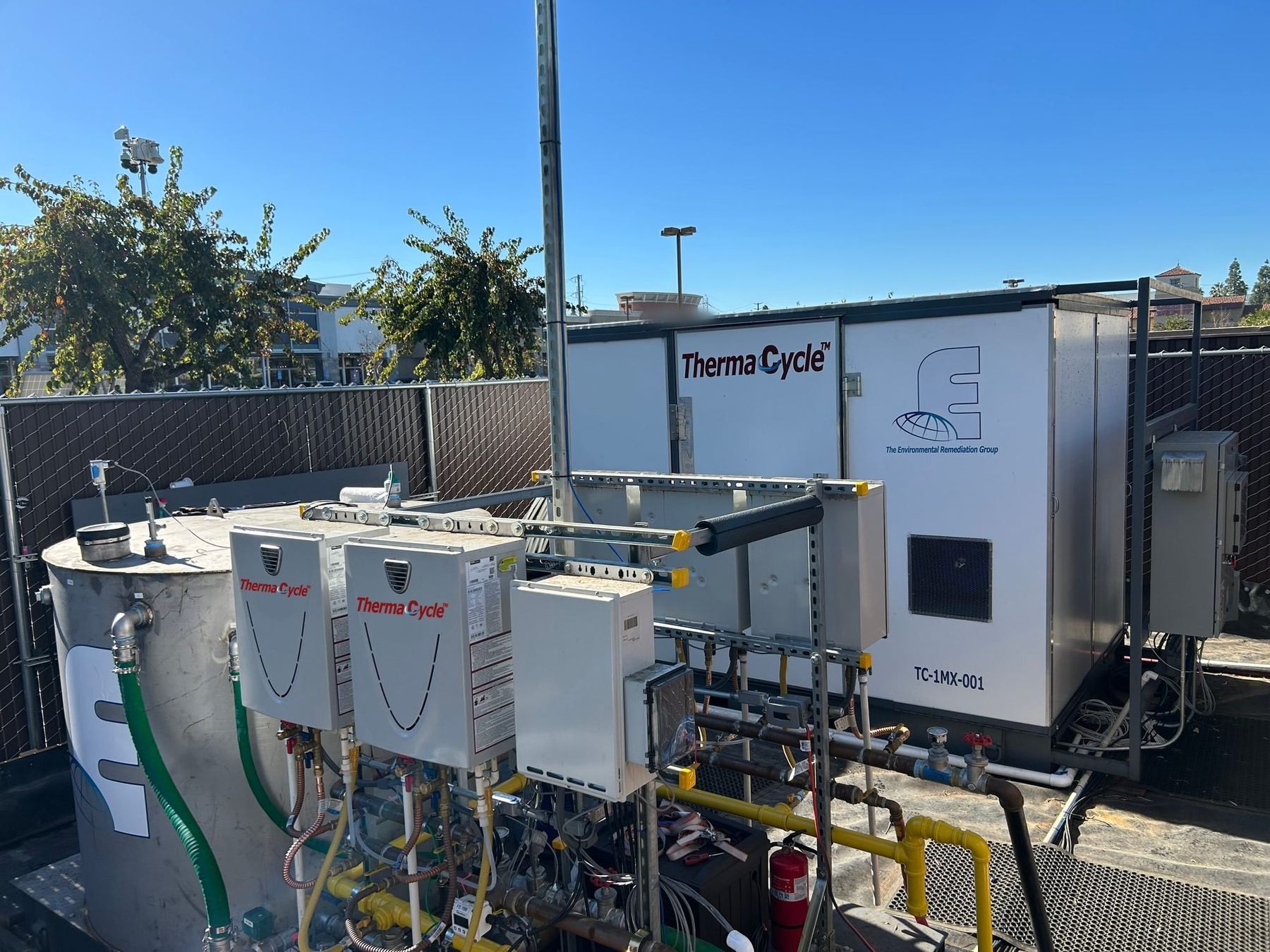
Each ThermaCycle® system is delivered as a fully piped, wired, and factory-tested skid, housed in a rugged 8.5 × 12 ft all-metal enclosure. The platform is driven by industrial-grade PLC controls, providing real-time telemetry, remote HMI access, automated alarm states, and continuous data logging.
Operators can dynamically adjust:
- Flowrates from 5 to 40 gpm
- Temperature lifts from modest 30–40 °F boosts for biological enhancement to aggressive ~105 °F lifts for hydrolysis or NAPL mobilization
- Amendment dosing through inline ports, chemical tanks, metering pumps, and static mixing valves
This architecture allows ThermaCycle® to respond directly to subsurface feedback—allowing operators (remote, or in the field) to adjusting heat and chemistry in real time as contaminant concentrations, geochemistry, and hydraulic behavior evolve.
A Backbone for Combined Remedy Strategies
ThermaCycle® is intentionally designed to function as either a standalone low- to mid-temperature thermal remedy or the central thermal engine within a combined remediation strategy.
Its closed-loop, amendment-ready design integrates seamlessly with chemical and biological injection technologies, enabling smooth transitions between:
- Surfactant- or co-solvent-assisted NAPL recovery
- Heat-Enhanced Chemical Oxidation or Reduction (ISCO/ISCR)
- Heat Enhanced Bioremediation & Recirculation
- Heat Enhanced Hydrolysis
Across complex stratigraphy, ThermaCycle® delivers predictable hydraulic capture, efficient contaminant recovery, and data-rich performance, while operating at significantly lower energy demand than high-temperature thermal conduction heating systems. Cleanup timelines typically range from months to a few years, depending on site conditions and remedial objectives.
The Takeaway
ThermaCycle® is not about pushing the subsurface to extremes.
It’s about applying the right heat, at the right time, for the right mechanism—and adapting as conditions change.
By unifying adaptive thermal delivery, controlled hydraulics, integrated chemistry, and real-time operational intelligence, ThermaCycle® transforms combined remedy strategies from theory into practical, efficient field application.
ThermaCycle®
Adaptive thermal remediation—engineered to evolve.